Florida Timesharing Lawyer: Protecting Your Time With Your Children
Few family law decisions feel as personal as deciding when your children will be with you. Florida time-sharing arrangements shape school nights, weekends, holidays and the everyday time you spend in your children's lives. Caroline Olson, PA helps South Florida parents build practical parenting arrangements around their children's needs and their family's real schedule.
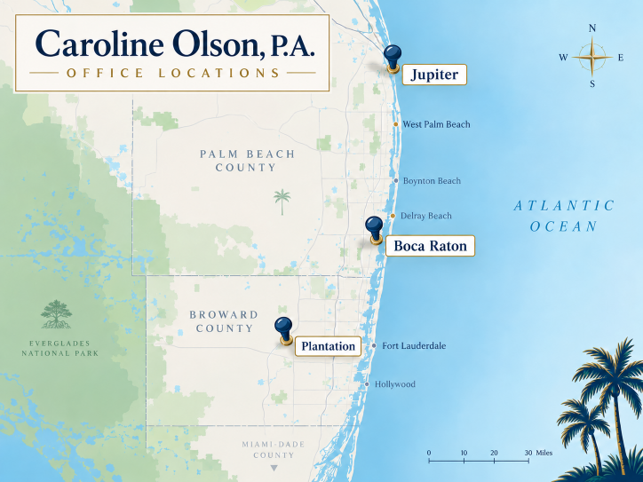
Serving South Florida families since 1999 from three convenient offices in Boca Raton, Jupiter and Plantation.
What Is Florida Time-Sharing and How Does It Work?
Under Florida Statutes Section 61.13, time-sharing refers to the schedule that determines when each parent spends time with a child. That schedule sits inside a parenting plan, which is the written structure parents use to raise their children across two households. Three concepts come up in nearly every case:
- Time-sharing: The schedule that sets when your child is with each parent, including school nights, weekends and holidays.
- Parental responsibility: The authority to make significant decisions about education, health care and other major aspects of your child's upbringing.
- Parenting plan: The court-approved document that combines the schedule, decision-making authority and day-to-day logistics into one plan.
These pieces work together, but each addresses a different part of parenting after separation or divorce.
Is 50/50 Time-Sharing Automatic in Florida?
Florida law presumes that equal time-sharing is in the best interests of a minor child. That presumption is rebuttable, meaning it can be overcome, and it applies unless the parents agree to a different arrangement. Equal time is a starting point, not a guarantee.
When parents cannot agree, a judge reviews the statutory best-interest factors in Section 61.13(3). These typically include:
- The needs of the child and each parent's ability to meet those needs
- The stability and continuity of the child's home, school and community
- Each parent's demonstrated capacity to be responsible and cooperative
- Each parent's ability to communicate about the child
Every family's facts shape the final schedule, which is why a one-size-fits-all formula rarely works.
What Does a Workable Time-Sharing Schedule Look Like?
The best schedule is one your family can realistically follow. A strong plan accounts for your children's ages, school calendars, activities, work obligations, transportation and travel time. Common formats include:
- Alternating weeks
- 2-2-5-5 schedules
- 3-4-4-3 schedules
- Customized schedules that reflect school nights, long-distance travel or a child's specific needs
None of these formats is the right answer simply because it is common. Examples are shown for general information only, and every family and parenting plan is different.
What Should a Parenting Plan Cover?
A clear parenting plan prevents many disagreements before they start. Beyond the basic calendar, a thoughtful plan often addresses:
- School days and school decisions
- Medical care and health insurance
- Holidays, birthdays and summer vacation
- Transportation and exchange locations
- Extracurricular activities
- Communication with the children and between the parents
Addressing these issues early gives both parents clear expectations and fewer opportunities for misunderstanding later.
When Can an Existing Time-Sharing Schedule Be Changed?
Children grow, school calendars shift and jobs change. A schedule that worked several years ago may no longer fit your family. Florida generally requires a substantial and material change in circumstances, along with a finding that the proposed modification serves the child's best interests. Common reasons families seek modification include:
- A parent's relocation
- Changes in a child's school, health or activity needs
- Changes in a parent's work schedule
- Repeated difficulty following the existing schedule
Caroline reviews your current order, explains your options and helps you decide whether modification is worth pursuing.
What Can You Do When the Other Parent Ignores the Parenting Plan?
Missed exchanges, repeated late returns and denied parenting time create stress for parents and children alike. You should not have to guess about your options. A practical first step is documenting each violation with dates, times and copies of relevant messages.
Caroline then evaluates whether the issue can be resolved through direct communication, negotiation or mediation, or whether court enforcement is necessary. Florida courts can address noncompliance with a parenting plan, and remedies may include make-up time and other relief depending on the facts.
Important:Withholding a child in response to unpaid child support is a common and costly mistake. Time-sharing and child support are separate court-ordered obligations, so speak with an attorney before taking that step.
Why Clients Trust Caroline Olson, PA With Their Families
Effective. Solution-oriented. Competent. Compassionate.
Caroline Olson, PA has served South Florida families since 1999. Her approach combines a clear explanation of the law with a practical understanding of what parents and children experience day to day. Whenever possible, she pursues resolution through discussion, negotiation or mediation. When agreement is not possible, she prepares carefully and advocates firmly through the court process.
"Here to guide you with competence and compassion as you close one difficult chapter and look to a brighter and more peaceful future."
— Caroline Olson, PA
Family Law Help Across Palm Beach and Broward Counties
Our three offices serve families throughout South Florida. Boca Raton and Jupiter cases typically proceed in Palm Beach County's 15th Judicial Circuit, while Plantation matters fall under Broward County's 17th Judicial Circuit.
Boca Raton Office
6501 Congress Avenue Suite 100 Boca Raton, FL 33487
Jupiter Office
601 Heritage Drive Suite 452 Jupiter, FL 33458
Plantation Office
8551 W. Sunrise Blvd. Suite 208 Plantation, FL 33322
We represent parents in Boca Raton, Boynton Beach, Jupiter, North Palm Beach, Palm Beach Gardens, Plantation, Wellington, West Palm Beach and surrounding communities.
Time-Sharing Often Connects to Other Family Law Issues
Parenting matters rarely exist in isolation. Depending on your circumstances, your case may also involve [Parenting Plans], [Child Support], [Paternity], [Relocation], [Enforcement], [Mediation] or [Divorce]. Caroline can help you address these issues together so your parenting plan and your financial obligations work in harmony.
"Here to guide you with competence and compassion as you close one difficult chapter and look to a brighter and more peaceful future."
Florida Timesharing FAQs
What does time-sharing mean in Florida?
Time-sharing is the schedule that sets when a child spends time with each parent. It is typically part of a parenting plan that also addresses parental responsibility and how parents make decisions about their children.
Is 50/50 time-sharing automatic in Florida?
No. Florida law presumes that equal time-sharing is in a minor child's best interests, but that presumption is rebuttable. The final schedule still depends on your family's circumstances and the statutory best-interest factors.
What is the difference between time-sharing and parental responsibility?
Time-sharing determines when the child spends time with each parent. Parental responsibility governs decision-making authority for significant matters, such as education and health care.
Can parents create their own time-sharing schedule?
Yes. Parents can negotiate a parenting plan and time-sharing schedule together. The court must still approve the agreement, and it must be consistent with the child's best interests.
What happens if parents cannot agree?
The court establishes a parenting plan and time-sharing schedule after evaluating Florida's statutory best-interest factors. The judge then issues an order that governs the family going forward.
Can my child decide which parent to live with?
A child's reasonable preference may be considered if the court finds the child has sufficient maturity to express one. The preference is one factor among many and does not give the child final authority over the schedule.
Can an existing time-sharing schedule be changed?
Possibly. Florida generally requires a substantial and material change in circumstances, along with a finding that the modification serves the child's best interests.
Can I stop time-sharing if the other parent has not paid child support?
No. Child support and time-sharing are separate court-ordered obligations. Withholding a child in response to unpaid support can create legal exposure, so speak with an attorney before taking that step.
What should I do if the other parent repeatedly violates our parenting plan?
Document each violation with dates, times and written communications. Then speak with a family law attorney about negotiation, mediation or court enforcement.
How much does it cost to speak with Caroline Olson about a time-sharing matter?
Caroline Olson, PA offers a Free Initial Consultation. Call (561) 288-0548 or complete the consultation form to get started.
FREE INITIAL CONSULTATION
Your Time With Your Children Matters
Whether you are establishing time-sharing for the first time, resolving a disagreement, modifying an existing plan or dealing with a parent who is not following the schedule, you do not have to work through the process alone. Caroline Olson, PA brings an effective, solution-oriented approach to family law, with competence, compassion and personal attention.

Contact Us
We will get back to you as soon as possible.
Please try again later.
Submitting this form does not create an attorney-client relationship. Please do not include confidential or time-sensitive information.